⇒BOTOX – What Is It? How Does It Work?
Botulinum toxin is a protein produced by the bacterium Clostridium botulinum. It is used in an injectable form and is injected into muscles. In Greece, the formulations BOTOX-VISTABEL (ALLERGAN) and DYSPORT-DYSLINE (IPSEN) are available.
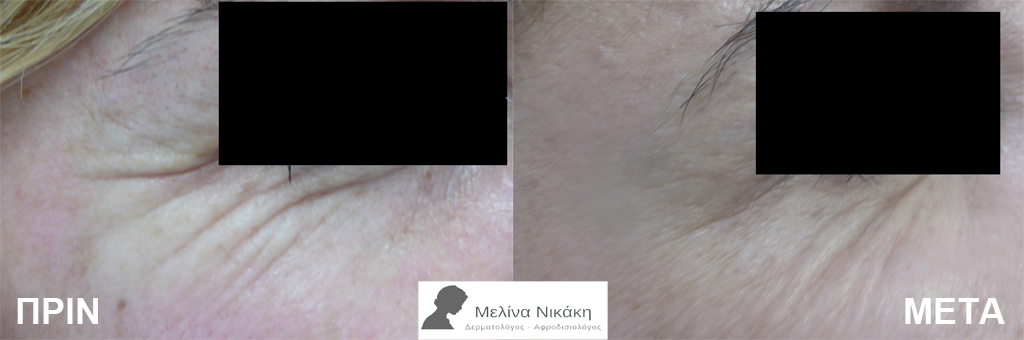
The injection is performed on the hyperkinetic facial muscles that cause expression lines to deactivate them. The botulinum toxin blocks signals sent by the nerves that instruct muscles to contract. The cessation of strong contractions consequently improves existing wrinkles and prevents their further worsening or the appearance of new ones.

√ Safety
It has been used in medicine since 1970. In 1992, it received FDA approval for cosmetic applications in Dermatology and Plastic Surgery and is considered the most popular cosmetic procedure worldwide.
⇒Where Is It Applied in Modern Dermatology?
The usual application sites are:
• Forehead (horizontal lines)
• Glabella (frown lines between the eyebrows)
• Periorbital wrinkles (crow’s feet)
However, in recent years, there are other application sites, such as:
• The sides of the nose (bunny lines)
• The vertical wrinkles above the upper lip (smoker’s lines or barcode lines)
• Neck wrinkles and the jawline (Nefertiti lift)
• The wrinkles from the corners of the mouth downwards (marionette lines)
• The chin
• The masseter (for bruxism)
Applications on the body:
- • Armpits, palms, soles (for treating hyperhidrosis)
Ø Contraindications
• Neuromuscular diseases, such as Myasthenia Gravis
• Pregnancy, breastfeeding
• Infection at the injection sites
• Known hypersensitivity to the ingredients of the formulation
• Use of certain medications (aminoglycosides, penicillamine, quinine, calcium channel blockers)
⊗ Side Effects
•Due to the use of a needle, some local bruising (hematoma), swelling, and pain may occur. These last for 4-5 days and can be treated with arnica cream or capsules and the use of ice packs.
• Headaches
• Eyebrow asymmetry
• More rarely, eyelid ptosis or double vision. These gradually resolve with medication (a specific eye drop).
The fact that the drug’s effect lasts for a specific period makes side effects or complications reversible. These are, in any case, rare if the procedure is performed by an experienced doctor.
◊ BOTOX Dosage
The dose of the substance injected is individualized because not all faces are the same, nor do they have the same muscle movement or needs.
It is logical that men and women with very hyperkinetic muscles require a higher dosage than people with less muscle movement or a smaller forehead area.
Also, a person who has been getting botox for years may need a smaller dosage.
Finally, because in recent years more and more young people want to prevent the appearance of permanent wrinkles, the dosage is smaller in these individuals (baby botox or actor’s botox).
$ Cost
Based on the above, it is clear that there cannot be a single price for everyone. As the necessary dosage varies, so does the cost of the procedure.
The appropriate and quality product, with the correct dilution, at the right dosage, and with the right application technique, is what will provide a perfect and safe result with the maximum possible duration.
Very low-cost offers, where we don’t know who is performing the procedure, should make us cautious. A low application cost may be associated with a shorter duration, leading to more frequent repetitions.
? How Long Does the Result Last?
Immediately after the application, there is no visible result. It takes 3-4 days for it to begin to affect the muscles and for the reduction in muscle movement to become noticeable, while the result is fully realized by the 20th day at the latest.
It remains at its maximum effect for about a month and then gradually begins to subside. The usual duration is 4-6 months. During this time, the wrinkles remain stable in their improved form.
We define the duration of botox as the time it takes for wrinkles to return to their original form, not the time the treated areas remain motionless. In other words, when the wrinkles reappear at rest, not just with movements and expressions.
The muscular structure of the face is of great importance in determining the duration of the result. We distinguish 3 types according to muscle tone:
• Orthokinetic type: There is an absolute synchronization of emotions and facial expressions. The result lasts 6-12 months. The treatment is usually done 1-2 times a year. These are the ideal candidates for botox.
• Hyperkinetic type: Muscle contractions do not synchronize with the expression of emotions but occur constantly. The result lasts 4-5 months or less. The treatment is repeated 3 times a year. This is the most common type we encounter.
• Hypertonic type: Similar to the hyperkinetic type, this is the opposite result of a lack of control, and the muscles are in constant contraction. The wrinkles do not disappear completely, and the muscle contraction is blocked for only 1-2 months. The goal of the treatment in this case is to convert the hypertonic type into a kinetic type.
Other factors that influence the result are:
• The correct dosage at the right points
• The correct dilution
• Proper storage: From the moment the vial is opened and the necessary dilution is made, it is stored in the refrigerator for a short period to keep the toxin active. Poor or prolonged storage of the toxin significantly reduces the duration of the result.
• Adherence to post-treatment measures to avoid very hot baths, smoking, alcohol, etc.
∗ What Should a Patient Know Before Getting Botox?
• That they are allowed to get it (a medical history is taken to rule out possible contraindications).
• Which type they belong to based on their muscle tone and how long the result is expected to last.
• There are different techniques and injection points, which is why the choice and experience of the doctor you trust for the application are so important.
• After the treatment, it is important not to lie down or bend over for 3-4 hours. Also, avoid massaging the treated area and makeup, alcohol, aspirin, anticoagulants, and exercise. Avoid sun exposure, hair dryers, and very hot water in the bath for the next 3-4 days.
• Deep-seated wrinkles will not disappear with botox and require combination treatments to be addressed.
• It is not advisable to repeat the procedure before the drug’s effect wears off, meaning no earlier than 3 months.
• In the same person, the duration in one area may be shorter than in another. In this case, a full application is recommended every 6 months, with an intermediate treatment every 3 months, for example, for the area with greater movement and limited duration.
• Usually, with consistent application, we find that the duration of the result gradually increases. However, this is not a rule! Even if the same doctor performs the same application on the same person, with the same dosage, and always adhering to the best standards (appropriate product, with due preparation and storage), the duration can vary. There are factors, sometimes unknown, that seem to affect the duration. In these cases, it is advisable to contact your doctor.
Αληθινά περιστατικά