
Free from acne
⇒What is acne?
It is a skin condition characterized by inflammation of the pilosebaceous units. It affects approximately 85% of teenagers and 12% of adults, primarily women.
What causes it?
The pathogenesis of acne is related to four factors:
- Hyperactivity of the sebaceous glands which leads to increased sebum production (linked to heredity or hormonal causes).
- Obstruction of the excretory pores of the sebaceous glands. The sebum produced by the sebaceous glands is channeled through the pores to the skin’s surface, but due to keratinization disorders, it causes pore obstruction. The obstructed pores are blackheads (open comedones) or whiteheads (closed comedones).
- Colonization of the follicle by P. acnes.
- Inflammation.
The swollen sebaceous glands become inflamed (red pimples/papules), and with the action of P. acnes, purulent lesions are formed (pustules). The progression of inflammation leads to the creation of nodules and cysts.
Factors that are implicated:
- Heredity
- Hormonal disorders
- Obesity
- Stress
- Use of inappropriate creams (cosmetics or sunscreens) and comedogenic cover-up products (makeup).


⇒How does it appear?
Clinically, acne appears with the following lesions:
- Comedones (open and closed)
- Papules
- Papulopustules
- Nodules
- Cysts
- Scars
Acne is mainly located on the face. It can also appear on the back, shoulders, and chest.
⇒How is it classified by severity?
- Mild (comedonal)
- Moderate (papular or papulopustular)
- Severe (nodular and cystic)

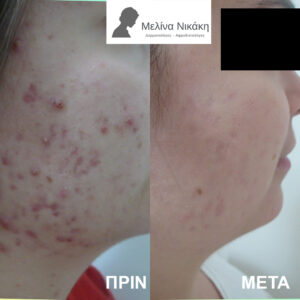
√ How long does it last?
In teenagers, acne lasts on average for 3-4 years and then, for the most part, disappears abruptly between the ages of 18 and 30. In recent years, patients with post-adolescent acne have very often appeared in our dermatology clinics; this acne appears after the age of 18 and is either a continuation of teenage acne or a new onset, and in 50% of cases, it is hormone-dependent.
◊ How is it treated?
Acne treatment is personalized and determined by its clinical manifestations and severity.
We distinguish the following treatments:
- Topical: antibiotics (clindamycin, erythromycin), anti-inflammatories (azelaic acid, benzoyl peroxide, adapalene), retinoid preparations (tretinoin, isotretinoin), and combinations thereof. The use of cleansing products and dermocosmetics is important regardless of the form of acne.
- Systemic: antibiotics (tetracyclines, minocycline), contraceptives, isotretinoin.
- Specialized treatments: these are treatments performed in the clinic.
? What is the treatment of acne in a dermatology clinic?
- care for acne-prone skin; rather, they supplement the treatment, make it more effective, and accelerate the results.In the dermatology clinic, the following are performed:
- Deep cleansing
Comedones are opened and sebum is extracted, while inflammatory lesions are also decongested. Skin antisepsis and the use of aseptic techniques are essential to prevent secondary infections. Antiseptic solutions, sterile tools (comedone extractors), high-frequency current, and soothing and anti-inflammatory masks are used. This is safe for all ages, even in children.
- Chemical peels
Peelings are applied both for active acne and for the scars that remain after it subsides. The main exfoliating agents used are trichloroacetic acid, alpha-hydroxy acids, pyruvic acid, and phenol.
Superficial peels are indicated mainly for the comedonal and papulopustular active forms, while all types of chemical peels can be applied even as a first-line treatment for scars, with results comparable even to those of fractional lasers (e.g., phenol peel).
- Phototherapy
This is a modern and safe treatment for acne that is a solution for those who do not want or cannot take drug therapy. It has been used for many years in medicine and is a clinically proven and effective technology.
The mechanism of action is simple: P. acnes (Propionibacterium acnes), which is responsible for the inflammatory lesions of acne, produces porphyrins, which are chemicals sensitive to blue light. When stimulated by blue light, porphyrins neutralize P. acnes, and the inflammation subsides and the pimples disappear.
In the treatment of acne, blue and red light are used, which exert antibacterial and anti-inflammatory effects. Blue light temporarily destroys P. acnes and is effective against inflammatory lesions, while red light is less active but penetrates deeper. The combination of blue/red light is effective even on comedones.
The effect of the light is further enhanced by the use of a photosensitizer that selectively accumulates in the target organ of acne, the pilosebaceous follicle (photodynamic therapy).
Phototherapy is painless, non-invasive, and does not cause any skin irritation. It requires a certain number of sessions, depending on the form of acne being treated. It is safe and requires only the use of special protective glasses.
- Fractional laser
This technology breaks down scar tissue, activates skin regeneration, revitalizing collagen and initiating the production of fibroblasts, resulting in tissue remodeling.
In our dermatology clinic, we use the Venus Viva, which utilizes the revolutionary NanoFractional RadioFrequency technology and the unique SmartScan technology, which offers superior results through the selective production of heat in the epidermis, minimizing the patient’s potential feeling of discomfort and increasing their satisfaction.
∗ Why should I treat my acne?
- Acne has serious consequences for quality of life and self-esteem: 56% of sufferers rank it as their top concern!
- Acne should be treated early because the treatment of mild acne prevents its progression to inflammatory and cystic acne.
- Acne that is not treated early and progresses to a severe form requires more potent therapy that requires systematic monitoring by a dermatologist and, consequently, more visits and blood tests.
- Acne must be treated early to prevent the formation of scars. Scars are much more difficult to treat than active acne and with more costly methods.
- Acne must be treated early to prevent the formation of post-inflammatory hyperpigmentation, as the dark marks on the skin are called where acne lesions were. Hyperpigmentation is persistent and lasts for months, and many patients consider it worse than even active acne.
- Neglected acne and delayed visits to the dermatologist increase the treatment time.
- Early treatment and maintenance of therapy prevent future flare-ups, while delayed treatment often leads to post-adolescent acne that troubles even adults aged 30, 40, and even 50.
How are the marks (scars) treated?
Acne scars are rarely hypertrophic and are usually atrophic and are divided into:
- Ice picks
- Boxcar
- Rolling
The treatments aim to detach the fibrosis that pulls the skin down and to activate the production of collagen and elastin and the regeneration of the skin.
The methods used are:
- Chemical peels
Peelings are applied both for active acne and for the scars that remain after it subsides. The main exfoliating agents used are trichloroacetic acid, alpha-hydroxy acids, pyruvic acid, and phenol.
Superficial peels are mainly indicated for the comedonal and papulopustular active forms, while all types of chemical peels can be applied even as a first-line treatment for scars, with results comparable even to those of fractional lasers (e.g., phenol peel).
- Microneedling
The treatment of atrophic acne scars is a common and widely studied indication for microneedling. It is effective for treating scars even on its own, while the results are enhanced by combining it with a glycolic acid peel, 15% trichloroacetic acid, PRP, or vitamin C. It is a safe and effective method for all skin types with minimal risk of hyperpigmentation.
- Subcision with special tools
- Elevation with the use of hyaluronic acid
- Fractional laser
This technology breaks down scar tissue, activates skin regeneration, revitalizing collagen and initiating the production of fibroblasts, resulting in tissue remodeling.
In our dermatology clinic, we use the Venus Viva, which utilizes the revolutionary NanoFractional RadioFrequency technology and the unique SmartScan technology, which offers superior results through the selective production of heat in the epidermis, minimizing the patient’s potential feeling of discomfort and increasing their satisfaction.
In our dermatology clinic, scars are treated with a personalized approach and the most modern therapeutic methods and state-of-the-art machines.