
What is a chemical peel?
A chemical peel, or chemical exfoliation, is a procedure in which one or more chemical agents are applied to the skin. These agents cause a controlled burn to the epidermis and/or part of the dermis, leading to the regeneration of damaged tissues without scarring. The goal is to improve skin texture, remove superficial skin lesions, and stimulate fibroblasts to produce collagen.
Depending on the depth of penetration of the chemical agent and the resulting tissue damage, we distinguish between light, medium-depth, and deep chemical peels.
At what age can I get a chemical peel?
There’s an age limit only for younger individuals. It can be applied from the age of 15-16 to anyone who needs a deep facial rejuvenation and does not fall into the contraindication categories.
For privacy reasons YouTube needs your permission to be loaded.
Can everyone get a chemical peel, or are there contraindications?
Peels should not be applied in the following cases:
- Pregnancy and breastfeeding.
- Immunodeficiency.
- Individuals taking medications that may cause photosensitivity (e.g., antidiabetics, antihypertensives, antipsychotics, certain analgesics).
- Patients who have used isotretinoin as an acne treatment in the last 6 months.
- Very sun-exposed skin that has become very thin (atrophic).
- Patients with an active outbreak of herpes simplex (for those with a history of recurrent herpes, a prophylactic antiviral treatment is given).
- Patients with a history of allergy to the chemical peel substances.
- Patients with a history of keloids or hypertrophic scars.
- Patients with warts or other infections on their face.
- Patients who have recently had plastic surgery on their face or eyelids.
- Patients who have undergone radiotherapy of the face and neck.
- Patients with emotional instability, psychiatric problems, and unrealistic expectations from the procedure.
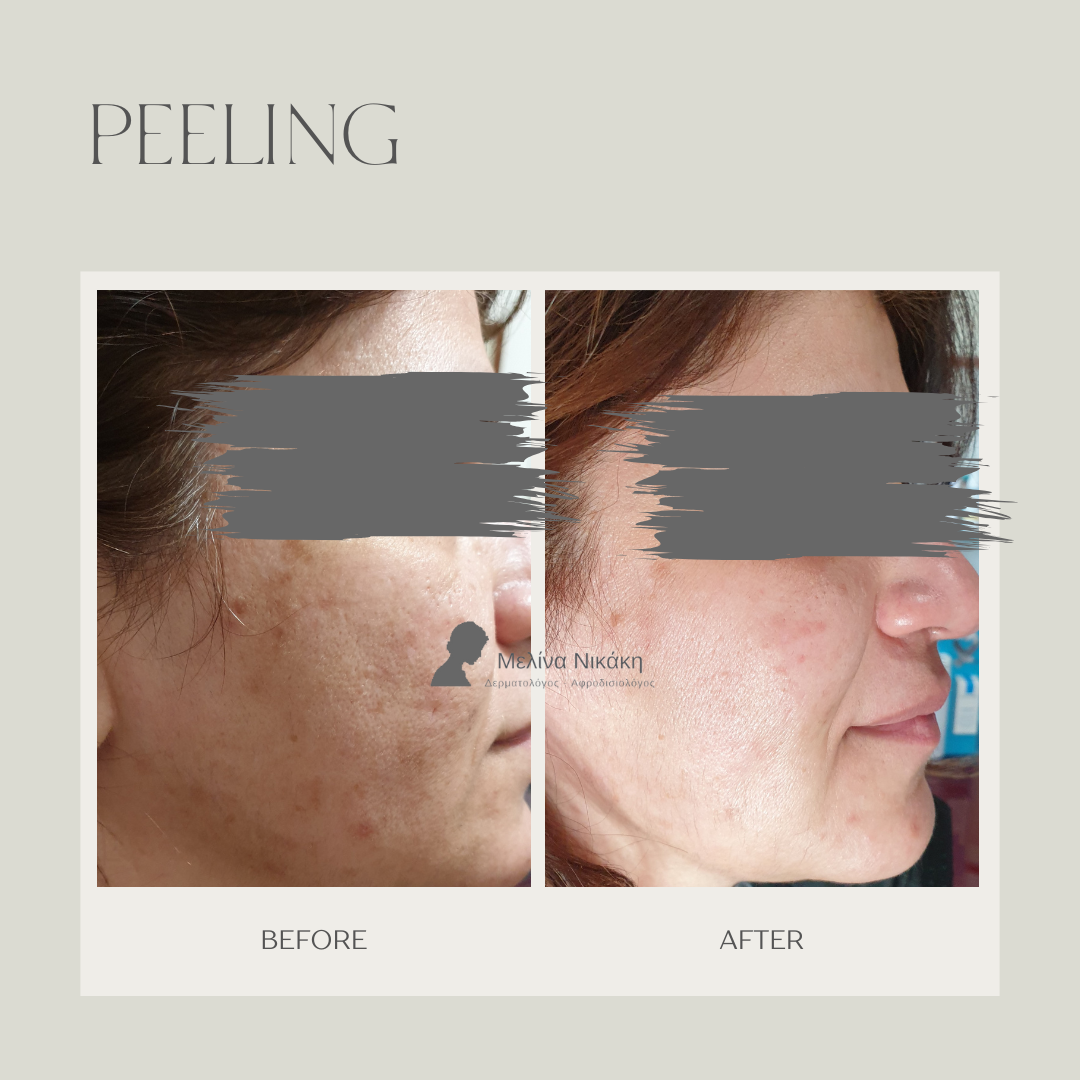
What should I do before the application?
When performing light chemical peels for cosmetic skin rejuvenation, no prior preparation is required from the patient.
In cases where a dermatologist applies a therapeutic peel to address discolorations, acne, or signs of aging, the patient must first use topical medication at home for 4-6 weeks before the application. This therapeutically prepares the skin so that the peel has an even better result and faster healing. For this purpose, retinoids (tretinoin, hydroxy acids) and whitening agents are used before and after chemical peels to reduce the risk of post-inflammatory hyperpigmentation. Sun protection is also essential.
The preparation is stopped one week before the application, and the use of treatments or products that may increase skin irritation from the acids is also discontinued. Things to avoid before the application include: hair dyes, perms, electrolysis and other hair removal methods on the face, other peels or skin scraping, topical acne treatments, intense sun exposure (sunbathing), and solariums.
What can be the effects of a chemical peel on the skin, and what should I be careful about?
Chemical peels can have immediate and delayed reactions.
- Immediate reactions appear within minutes or hours as a burning sensation, redness, swelling, and dermatitis.
- Delayed reactions include skin inflammation, crusting, peeling, scarring, pigmentation disorders, and an outbreak of cold sores. These should be treated aggressively and immediately to avoid post-inflammatory hyperpigmentation, especially in people with a dark skin tone.
Of course, the post-application process and recovery times depend on the depth of the peel.
- For superficial peels, a mild redness and possibly gentle peeling usually appear within the next 3-7 days (this peeling may not even be visible on very resilient skin). The more intense redness seen after the procedure disappears in about two hours, leaving only a very mild redness. Some patients may not experience any visible signs as a result of the treatment, but the benefit of exfoliation is still there.
- For medium-depth and deep peels, a brownish crust may appear more frequently, which gradually falls off. The speed of healing is a qualitative characteristic of the skin but also depends on age (older skin tends to heal less quickly). The skin usually heals in 7-10 days.
- Deep chemical peels are very invasive, causing a chemical burn and requiring long recovery times (15-30 days). They also require specific post-operative medication to prevent infections with antibiotics and sometimes systemic corticosteroids.
For medium or deep peels, there are more post-treatment instructions, and the patient must be more careful and have certain restrictions.
- Use mild painkillers, such as paracetamol, if needed.
- Apply a thin layer of antibiotic ointment 2-3 times daily to reduce the risk of infection.
- If you suffer from severe itching during recovery, it is recommended to take antihistamines to stop the symptoms.
- Sleep on your back with your head elevated on a few pillows to reduce swelling during sleep.
What should I avoid after a chemical peel?
In general, post-peel care includes:
- Using mild cleansing soaps and cold water to wash the face.
- Proper skin hydration, using healing creams, sunscreens, and other sun protection methods until the peeling is complete and the skin is fully healed.
- During this period, to avoid the possibility of scarring, do not peel, scratch, pick, or scrape the skin.
- For the next few days, it’s a good idea to avoid exposure to intense heat (aerobic exercise, hairdryer, sitting near a fireplace, etc.).
- Do not hold the hairdryer too close to your face when drying your hair.
- Do not use very hot water in the bath, and wash your face with cold water.
- Do not sit near stoves, radiators, or over the kitchen while cooking. Be very careful with the steam from the iron when ironing.
- Avoid intense physical exercise for about two weeks to allow for a smooth recovery.
- Avoid aggressively rubbing your face.
- For at least one month after the peel, avoid hair removal with electrolysis or wax.
- Start using sunscreen with a high SPF and avoid direct sun exposure for at least 6 weeks.
- Contact your doctor immediately if you notice signs of infection or color changes.
Sun protection is also recommended for several weeks afterward with a high-SPF sunscreen, which should be used at all times of the day to reduce the possibility of post-inflammatory hyperpigmentation.
How often can I get a chemical peel?
Superficial chemical peels can be done every 2-4 weeks, medium-depth peels every 3-6-9 months (and should not exceed 3 per year, depending on the intensity), while deep peels are done annually.